
Measuring a 4 Arms Rotary Washing Line sounds simple, but doing it correctly saves you from the two most common problems: buying a line that doesn’t fit your garden space, or installing it at a height that makes laundry drag on the ground. Whether you’re replacing an old arms rotary washing line or planning a first-time install, the goal is to measure the dimensions that affect capacity, clearance, stability, and everyday usability.
Below is a professional, step-by-step method you can follow with a tape measure in under 10 minutes.
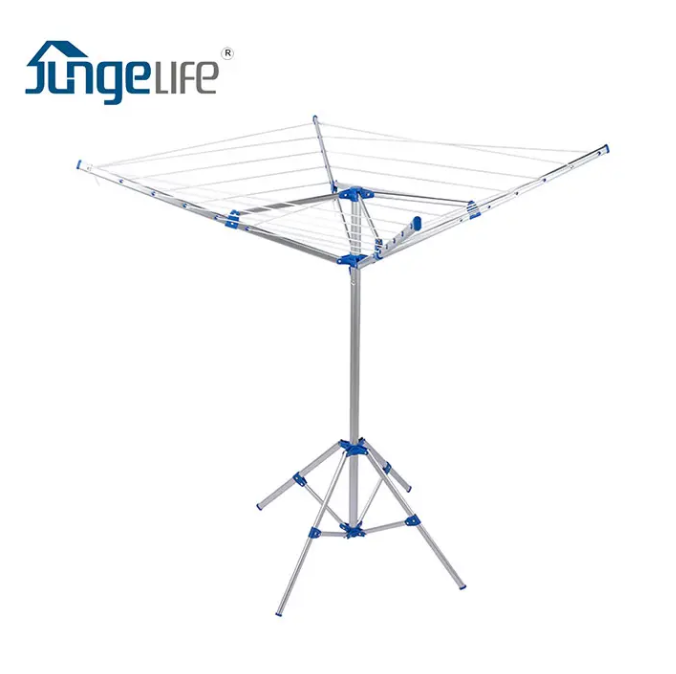
1) Measure the “Drying Diameter”
The most important measurement is the overall drying diameter—the circle the rotary line creates when fully open.
How to measure:
- Open the washing line fully.
- Measure from the tip of one arm straight across to the tip of the opposite arm.
This number tells you:
- How much clear space you need in the garden (no fences, sheds, trees).
- How far clothes will swing in wind.
Practical sizing tip: add at least 50–70 cm (20–28 in) of extra clearance around the diameter for airflow and to prevent sheets hitting obstacles. For example, if your 4-arm model measures 2.0 m across, plan for roughly 3.0–3.4 m of open area.
2) Measure Arm Length
If you can’t measure tip-to-tip (tight space), measure the arm length:
- From the center pole to the arm tip.
Then calculate:
- Drying diameter = arm length × 2
Arm length is also a quick way to compare different 4-arm models, because longer arms usually mean more line length and better spacing for bulky items.
3) Measure “Working Height”
Working height affects comfort and laundry clearance. Measure:
- Ground to the lowest line (or where the outer lines sit when loaded)
- Ground to the highest line (some designs have tiered lines)
How to measure:
- Install the pole (or simulate installed position).
- Extend the line to the usual operating height.
- Measure from ground level to the line.
Professional guidance:
- For most users, a comfortable clothesline height is around 160–190 cm (63–75 in) to the main line level.
- Ensure long items (bath towels, trousers, bedding) stay at least 20–30 cm (8–12 in) above the ground to avoid dirt and moisture.
If multiple people use the line, choose an adjustable model. Height adjustment is a major “quality of life” feature and reduces shoulder strain over time.
4) Measure Total Line Length
Manufacturers often advertise capacity as “total line length,” e.g., 30 m, 40 m, 50 m. This is the sum of all lines across all arms and tiers.
How to estimate yourself:
- Count how many parallel lines run on one arm.
- Measure the usable length per line (usually close to arm length).
- Multiply: arm length × number of lines per arm × 4 arms
(then adjust slightly if the line is anchored inward from the arm tip)
Why it matters:
- A typical full household load may require 15–25 m of line space, while bedding and family loads often benefit from 40 m+.
- More line length also improves spacing, which can reduce drying time by improving airflow.
5) Measure Folded Size
If you plan to store the unit in a shed or use a protective cover, measure:
- Folded height (top to bottom)
- Folded width (widest point across folded arms)
A compact folded profile matters in smaller gardens and helps extend product life by protecting it from UV and rain.
6) Measure the Pole Diameter and Ground Socket Requirements
Installation compatibility is often overlooked. Measure:
- Pole diameter (common sizes are around 32–50 mm, depending on design)
- Ground spike or socket internal diameter
- Depth of the installed sleeve or concrete footing
Stability tip: for windy areas or large-diameter rotary lines, a deeper, well-set socket reduces wobble. Less wobble means less line tangling and less mechanical wear on the lifting mechanism.
7) Quick Checklist
Before you buy or replace a 4-arm unit, record:
- Drying diameter (tip-to-tip)
- Arm length (center-to-tip)
- Working height (ground to line)
- Total line length (manufacturer spec or your estimate)
- Folded size
- Pole diameter + socket depth
Bottom Line
To measure a 4 Arms Rotary Washing Line, focus on the dimensions that impact real-world use: drying diameter, arm length, working height, total line length, folded size, and pole/socket specs. With these measurements, you can confidently choose a rotary line that fits your space, holds your typical laundry volume, and dries faster thanks to better spacing and airflow. If you share your garden dimensions and your typical laundry load size, I can recommend the ideal diameter and line-length range for your setup.
Post time: Jan-19-2026